Recalibrating After the Long Haul: A Practical Protocol for Beating Jet Lag on Your Saigon Business Trip
There is a particular cruelty to the US-to-Vietnam flight path. By the time an executive departing the East Coast clears customs at Tan Son Nhat International Airport, their body believes it is somewhere between midnight and three in the morning — regardless of what the Saigon sun insists outside the terminal doors. The brain, operating on the circadian rhythms of a different continent, is simultaneously exhausted and unable to sleep, alert and unable to focus. It is not a pleasant state. In a business context, it is a genuinely dangerous one.
Cognitive science has documented what frequent long-haul travelers know intuitively: jet lag does not merely make you tired. It measurably degrades the executive functions most essential to professional performance. Working memory contracts. Emotional regulation becomes effortful. Risk assessment grows unreliable. The traveler who would never sign a contract without careful review may, in a jet-lagged state, gloss over precisely the clause they would otherwise scrutinize most carefully.
For US executives traveling to Ho Chi Minh City on business, managing this physiological reality is not optional. It is a professional obligation — and the tools available to manage it are more sophisticated than most travelers recognize.
Understanding the Specific Challenge of the US-to-Vietnam Corridor
Flights from major US hubs to Ho Chi Minh City typically involve a time difference of eleven to thirteen hours, depending on the departure city and the season. This is not a jet lag scenario where the body adjusts after a good night's sleep. Research from sleep medicine specialists, including work published through the American Academy of Sleep Medicine, indicates that recovery from time zone shifts of this magnitude requires approximately one day per hour of time difference crossed — a timeline that places full physiological recovery well beyond the average business trip duration.
This means the objective is not full recovery. It is managed performance: structuring the first forty-eight to seventy-two hours in a way that protects cognitive function during the moments it matters most, while allowing the body to recalibrate as efficiently as possible.
Ground transportation, applied strategically, plays a more significant role in this protocol than most executives initially appreciate.
The Airport Arrival Window: Your First Critical Decision
The moment you clear customs and step into Saigon's arrivals hall is not a moment for improvisation. You are, at this juncture, likely operating on minimal sleep, in an unfamiliar environment, in heat and humidity that will feel genuinely shocking if you have not visited before. The decisions you make in the next thirty minutes — how you get to your hotel, how you manage your first hour in the city — will either accelerate or extend your recovery window.
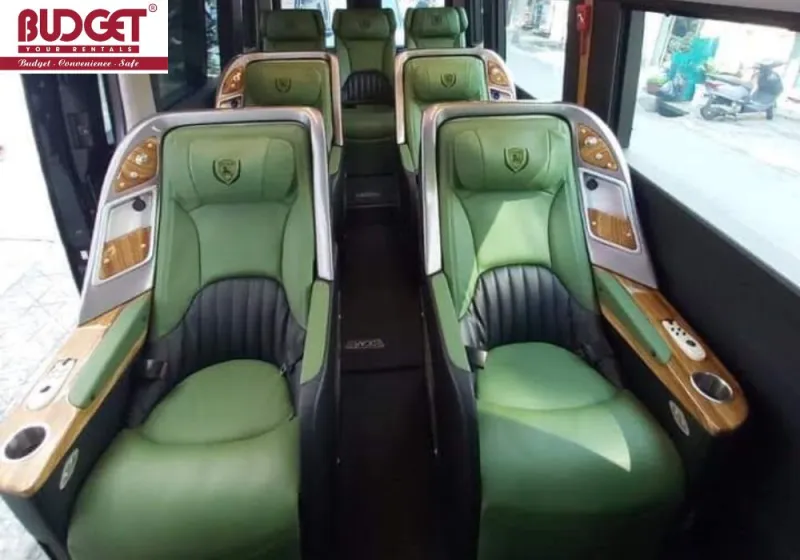
A pre-arranged luxury transfer eliminates the single greatest energy drain of the arrival experience: uncertainty. There is no need to navigate taxi queues, negotiate fares in a language you do not speak, or decode a rideshare application that may not function reliably in a new country. Your driver is present, identified, and ready. Your vehicle is climate-controlled — a consideration that is not trivial when the ambient temperature outside the terminal frequently exceeds ninety degrees Fahrenheit.
The twenty-five to forty-five minutes between the airport and your hotel is, in a private vehicle, a genuine recovery asset. Business coaches who specialize in executive travel performance — including practitioners affiliated with the International Coaching Federation who work with high-frequency international travelers — consistently recommend using this transition window for a specific protocol: close your eyes, avoid your phone, and allow your nervous system to begin downshifting from the sustained alertness of long-haul travel. A private cabin makes this possible. A shared shuttle or standard taxi does not.
Climate, Light, and the Circadian Reset
Neuroscience research on circadian rhythm disruption has identified light exposure as the single most powerful tool available for accelerating time zone adjustment. The specific recommendation for travelers arriving in the morning or midday — as many US-to-Vietnam flights do — is to seek natural light exposure during the first afternoon, even when every biological signal argues for immediate sleep.
This is where the vehicle environment becomes strategically relevant. A luxury transfer service can be directed to take a route that keeps you in natural light — perhaps past the open boulevards of District 1 rather than through the more enclosed streets of older districts — without adding meaningful time to the journey. More practically, a driver who understands your itinerary can help you calibrate the timing of your arrival at the hotel relative to optimal light exposure windows.
Conversely, if you are arriving on a late-night flight and your priority is immediate sleep, the darkened, temperature-controlled environment of a premium vehicle begins the sleep preparation process before you reach the hotel — a meaningful advantage when every minute of quality rest in the first twenty-four hours carries outsized recovery value.
Protecting Decision-Making Capacity During the Critical Window
The first two days of a business trip to Vietnam are frequently the most consequential. Relationship-building dinners, facility tours, and preliminary negotiation sessions are often scheduled early in the visit, before the local counterpart's schedule fills with competing demands. This creates a direct collision between the moments of maximum professional exposure and the period of maximum physiological vulnerability.
The most effective mitigation strategy available to US executives involves structuring their ground transportation to create deliberate recovery micro-windows throughout the day. Rather than walking between engagements — which, in Saigon's heat and traffic, is rarely practical in any case — the vehicle becomes a mobile decompression chamber between meetings. Fifteen minutes of quiet transit, with eyes closed and phone holstered, can meaningfully restore attentional resources in a way that a cup of coffee cannot replicate.
This is not a luxury indulgence. It is applied neuroscience. Research from institutions including Harvard Medical School's Division of Sleep Medicine has demonstrated that even brief periods of wakeful rest can partially restore the cognitive performance degraded by sleep deprivation — provided the environment is sufficiently calm and stimulus-free. A well-appointed private vehicle is, in Saigon's context, one of the few such environments reliably available.
The 72-Hour Framework
For US executives arriving in Ho Chi Minh City, the following framework organizes the recovery protocol around available transportation infrastructure:
Hours 0-6 (Arrival and Transit): Pre-arrange your airport transfer. Use the vehicle journey for passive rest, not phone review. Arrive at your hotel with your nervous system partially reset rather than further stimulated.
Hours 6-24 (First Afternoon and Evening): Seek light exposure if arriving during daylight. Avoid extended napping. Use vehicle transit between any early-evening engagements as deliberate rest windows. Request a slightly longer route if the additional time serves a recovery purpose.
Hours 24-48 (Day Two): Your body's adjustment has begun but is incomplete. Schedule your most cognitively demanding meetings no earlier than mid-morning. Use pre-meeting transit time for focused preparation rather than email management.
Hours 48-72 (Day Three): Most executives report meaningful functional improvement by this point. Maintain the transit-as-recovery-tool habit, as cumulative fatigue can resurface unexpectedly, particularly after intensive social engagements.
A Final Consideration
Saigon rewards the prepared traveler. Its commercial energy, its density of opportunity, and its pace of business can be exhilarating — but only for the executive who arrives with their cognitive faculties intact. The jet lag recovery protocol outlined here is not about traveling in comfort for its own sake. It is about ensuring that the professional who steps out of that vehicle at each engagement is the same sharp, composed, and strategically capable individual who boarded the flight in the United States.
The journey, managed well, is where that preparation happens.