The Cognitive Edge: How a Luxury Vehicle's Interior Environment Shapes Business Conversations in Ho Chi Minh City
Negotiations rarely begin at the conference table. Long before the formal agenda is introduced, the conditions under which two parties first engage — the ambient noise, the physical comfort, the degree of privacy — are already shaping cognitive states, emotional receptivity, and willingness to concede. For US business travelers operating in Ho Chi Minh City, where deals are frequently initiated or advanced during transit, the interior of a luxury vehicle is not merely a convenience. It is a controlled environment with measurable psychological consequences.
The city's relentless energy is part of its appeal, but it also presents a specific challenge: Saigon's streets are loud, dense, and unpredictable. Standard transportation options expose occupants to that chaos in ways that fragment attention and elevate stress hormones. A premium limousine, by contrast, functions as a deliberate counterpoint — a sealed, curated space designed to preserve cognitive clarity precisely when it matters most.
The Acoustics of Agreement
Sound is among the most underestimated variables in negotiation psychology. Research in environmental psychology consistently demonstrates that elevated ambient noise degrades working memory, narrows attention, and increases cognitive load — all conditions that undermine nuanced decision-making. In a city where motorbike traffic, construction, and street commerce generate a near-constant sonic backdrop, the acoustic insulation of a high-end vehicle cabin is not a luxury feature. It is a strategic asset.
Within a properly appointed limousine, the external world recedes to a low, indistinct murmur. Conversation carries naturally, at a volume that does not require effort or repetition. This seemingly minor detail has a compounding effect: when both parties can hear each other clearly without strain, the cognitive bandwidth that would otherwise be consumed by auditory processing is freed for higher-order thinking — parsing nuance, weighing proposals, reading interpersonal signals. The result is a conversation that feels less labored and, critically, one in which both participants are more likely to remain engaged rather than mentally fatigued.
For the US executive who arrives in Saigon after a 20-plus hour journey, this acoustic sanctuary is doubly valuable. Jet lag already taxes working memory and executive function. Layering additional sensory noise on top of that physiological deficit compounds the disadvantage significantly. Removing that noise, even partially, helps restore the cognitive parity that effective negotiation demands.
Temperature, Comfort, and the Physiology of Persuasion
Ho Chi Minh City's climate is unambiguous: warm, humid, and persistent. For visitors acclimated to the temperate rhythms of the American Midwest or the dry heat of the Southwest, the thermal environment of southern Vietnam can be genuinely disorienting during the first days of a trip. Discomfort, even mild discomfort, is a well-documented distractor — one that subtly shifts attention inward and away from the external conversation at hand.
A luxury vehicle with precise climate control eliminates this variable. The cabin temperature in a properly maintained limousine is maintained at a level that promotes alertness without inducing the drowsiness that often accompanies over-cooled spaces. This calibration is deliberate. Comfort that is too aggressive — an excessively cold interior, for instance — can suppress the physiological arousal that underpins sharp thinking just as effectively as heat and humidity. The ideal cabin environment supports a state of relaxed attentiveness: the cognitive sweet spot in which listening is active, responses are considered, and decisions are made with confidence rather than urgency.
For a counterpart who is riding in standard transportation — exposed to the city's heat in a less controlled environment — the contrast upon entering a well-appointed limousine can itself be a form of soft influence. Comfort has a disarming quality. A guest who is physically at ease is neurologically predisposed toward openness, a dynamic that experienced negotiators understand and cultivate.
Spatial Layout and the Psychology of Proximity
The physical configuration of a luxury vehicle cabin introduces another dimension that standard transportation cannot replicate: the management of interpersonal space. In behavioral science, proxemics — the study of how physical distance affects social interaction — has long established that spatial arrangement influences perceived authority, trust, and conversational openness.
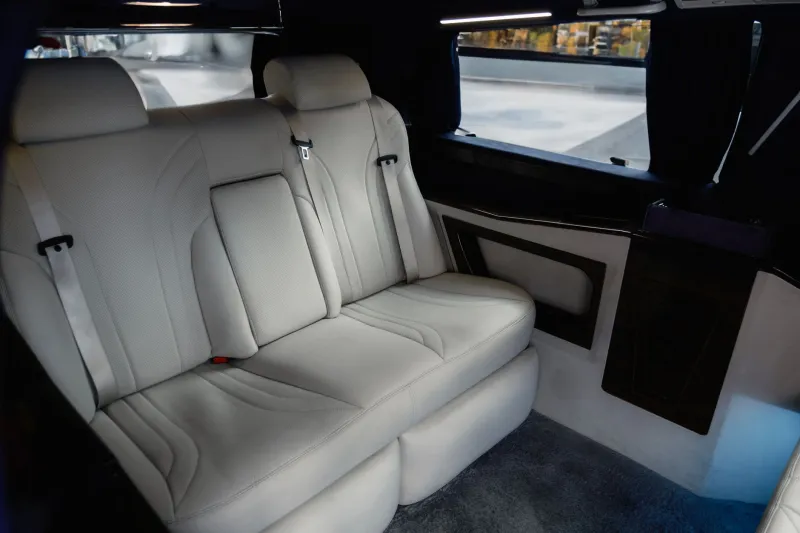
A well-designed limousine cabin provides face-to-face or angled seating arrangements that facilitate genuine dialogue rather than the side-by-side positioning common in standard sedans. This orientation matters. Direct but not confrontational eye contact, the ability to observe body language, and the natural back-and-forth rhythm of a conversation conducted in a properly configured space all contribute to the quality of the exchange. The setting signals that this is a conversation worth having — structured, intentional, and worthy of attention.
Additionally, the spatial generosity of a luxury cabin reduces the psychological compression that confined spaces can produce. Feeling physically constrained is associated with heightened defensiveness and reduced cognitive flexibility — precisely the opposite of what a productive business conversation requires. The openness of a premium interior, even within the confines of a moving vehicle, communicates ease and control.
Lighting and the Subtle Architecture of Focus
Ambient lighting within a vehicle cabin is rarely discussed in the context of business outcomes, yet its influence is tangible. Harsh or inconsistent lighting increases visual fatigue, particularly relevant for travelers reviewing documents, examining contracts, or referencing data on a device during transit. Soft, evenly distributed cabin lighting reduces eye strain, supports sustained focus, and creates an atmosphere that feels considered rather than incidental.
This distinction — between a space that feels considered and one that feels incidental — is perhaps the most important psychological variable of all. When a meeting environment signals intentionality, participants unconsciously assign greater weight to the conversation taking place within it. The implicit message is that the person who arranged this environment takes the interaction seriously. In Saigon's corporate culture, where respect and preparation carry significant relational weight, that signal is received clearly.
The Competitor Who Doesn't Know What They're Missing
Perhaps the most instructive way to understand the advantage of a curated mobile environment is to consider its absence. A counterpart who travels by standard taxi or ride-share arrives at the same destination having navigated noise, heat, physical discomfort, and the cognitive taxation of an uncontrolled environment. Their mental resources have been partially consumed before the conversation even begins.
The executive who steps out of a properly appointed limousine has spent that same transit time in conditions designed to preserve and sharpen cognitive function. They have arrived, in the truest sense of the word — present, composed, and ready.
In Ho Chi Minh City's high-stakes business environment, where the margins between a successful outcome and a missed opportunity are often narrow, that difference is not trivial. It is, quietly, everything.