The Weight Off Your Shoulders: How Elite Baggage Coordination Redefines the Arrival Experience in Ho Chi Minh City

There is a particular kind of exhaustion that has nothing to do with sleep deprivation. It accumulates not in the muscles but in the mind — the low-grade, persistent drain of managing logistics under pressure. For US executives arriving at Tan Son Nhat International Airport after a fourteen-hour flight from Los Angeles or a connecting leg from Singapore, that exhaustion often peaks not at 35,000 feet but in the chaotic minutes after landing, when the physical demands of international travel converge with the cognitive demands of being somewhere important.
Baggage, in this context, is rarely discussed as a strategic variable. It should be.
The Invisible Tax of Conventional Arrival
Consider what the standard arrival process actually requires of you. You deplane, navigate immigration, stand at a carousel for an indeterminate stretch of time, collect bags that may or may not have traveled the same route you did, negotiate a crowded arrivals hall, and then attempt to locate transportation while managing two or three pieces of luggage through a terminal that was not designed with your schedule in mind.
None of these steps are cognitively demanding in isolation. Together, however, they constitute what behavioral economists call a decision and attention tax — a cumulative depletion of the mental resources you were planning to deploy in a meeting three hours from now. By the time a conventionally arriving executive reaches their first appointment, they have already spent a meaningful portion of their sharpest thinking on tasks that contributed nothing to the outcome they flew halfway around the world to achieve.
Elite ground transportation addresses this tax at its source.
What Professional Coordination Actually Looks Like
The distinction between a luxury limousine service and a standard car hire is not, at its core, about the vehicle. It is about the architecture of the handoff — the precise choreography that begins before your wheels touch Vietnamese soil.
With a service such as Saigon Elite Rides, the coordination sequence initiates at the flight-tracking stage. Your driver and the supporting logistics team monitor your inbound flight in real time, adjusting ground-side positioning to account for early arrivals, gate changes, and the variable pace of immigration queues at Tan Son Nhat. This is not passive waiting. It is active management.
When a meet-and-greet protocol is engaged, a uniformed representative enters the arrivals process at the earliest permissible point — often within the terminal itself — and assumes responsibility for the physical logistics of your transition. Luggage identification, trolley management, customs navigation support, and the movement of your bags from carousel to vehicle are handled by someone whose sole professional purpose in that moment is to ensure that you expend zero attention on any of it.
You walk. Someone else carries.
The psychological effect of this arrangement is more significant than it may initially appear.
Cognitive Load and the Science of Arriving Ready
Research in cognitive psychology has long established that mental bandwidth is a finite resource, and that tasks requiring physical attention — even simple ones like pulling a suitcase — compete for the same neural resources as tasks requiring strategic thought. When the physical demands of arrival are absorbed by a professional support team, the executive's mental state upon entering the vehicle is measurably different from what it would have been after a conventional arrivals experience.
This is the premise on which elite ground transportation justifies its positioning: not luxury as indulgence, but luxury as performance infrastructure.
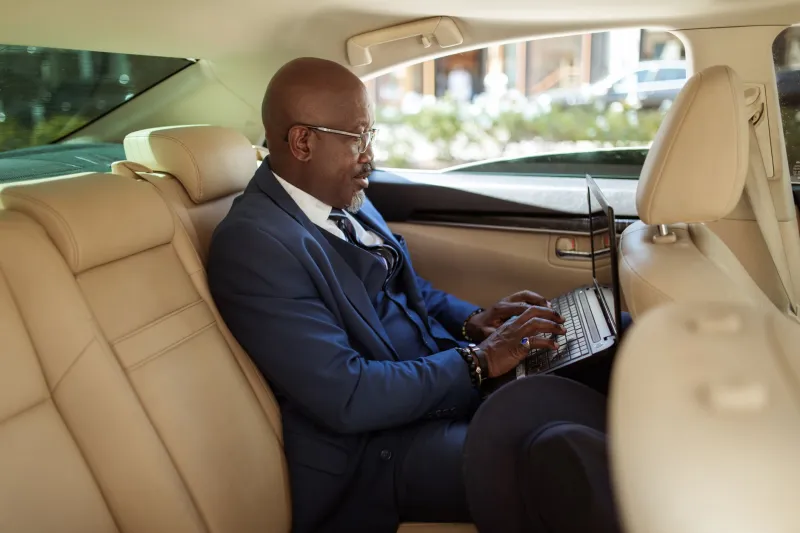
The cabin of a properly appointed limousine, reached without the friction of luggage management, becomes something qualitatively different from a car. It becomes the first controlled environment you have occupied since your departure gate. Climate-regulated, acoustically insulated, and free from the ambient chaos of the terminal, it offers the conditions necessary for genuine mental recalibration — a window of quiet in which to review notes, organize priorities, or simply allow the nervous system to settle before the first handshake.
The Specific Protocols That Separate Elite Services
Not every service that markets itself as premium actually delivers on the logistics side. The differentiators worth examining before you book are specific and operational.
Flight monitoring with proactive adjustment. Your driver should not be waiting for you to send a text announcing your landing. The service should already know — and should have repositioned accordingly if your flight arrived early or late.
Named meet-and-greet with luggage assistance. A sign bearing your name is a minimum standard. What distinguishes an elite service is the representative's familiarity with the arrival sequence: knowing which carousel your flight uses, anticipating the pace of immigration for your passport category, and having a trolley ready before your bags appear.
Secure, supervised luggage transfer. Your bags should never be out of sight of a responsible party between the carousel and the vehicle. In a busy international terminal, this is not a minor detail — it is a material security consideration for executives traveling with sensitive materials, devices, or documents.
Vehicle loading handled entirely by staff. You should enter the vehicle unencumbered. Luggage is loaded, organized, and secured by your driver or support team. Upon arrival at your hotel or office, it is unloaded with equivalent attention.
Continuity of service across the full transfer. The same vehicle, the same driver, and the same itinerary awareness that governed your airport pickup should carry through to every subsequent transfer during your stay. Your bags, your schedule, and your preferences should not need to be re-explained at each leg of the journey.
The Compounding Return on a Frictionless Arrival
For the executive who arrives in Ho Chi Minh City once or twice a year, a seamless baggage handoff may seem like a pleasant convenience. For the executive who travels to Saigon quarterly — or who uses the city as a regional hub for broader Southeast Asian operations — the cumulative effect of consistently frictionless arrivals represents a genuine and measurable return on investment.
Each trip begins with full cognitive capacity rather than a depleted reserve. Each first meeting is entered from a position of composure rather than recovery. Each schedule runs on the timeline you planned rather than the one the airport imposed.
In a business environment where relationships are built on impressions and impressions are formed in minutes, the state in which you arrive is not incidental to the outcome. It is constitutive of it.
The weight of your luggage, managed by someone else, is the smallest part of what elite ground transportation lifts from your shoulders.