When the App Fails You: The True Price of Ride-Sharing in Ho Chi Minh City's Corporate Arena

There is a particular kind of silence that falls over a conference room when the American executive walks in seventeen minutes late, visibly flustered, phone still open to a map application that led him to the wrong district entirely. No apology fully repairs it. No explanation — however accurate — restores the authority that evaporated the moment he arrived behind schedule, breathless, and unprepared.
This scenario plays out with quiet regularity in Ho Chi Minh City. And almost invariably, a ride-sharing application is somewhere in the story.
The Illusion of Frictionless Transportation
For business travelers arriving from major American cities, ride-sharing apps carry the comfortable familiarity of home. In New York, Chicago, or Los Angeles, pulling up Grab or Gojek feels no different from summoning an Uber — a transaction completed in seconds, a vehicle dispatched, a destination confirmed. The assumption is that the technology translates seamlessly across geographies.
It does not.
Ho Chi Minh City operates according to a logic that no algorithm has fully decoded. The city's address system, while officially standardized, exists in practice as a layered palimpsest of old colonial street names, post-reunification renaming, local nicknames, and informal landmark-based navigation that residents use instinctively and visitors find impenetrable. A single address can point to multiple physical locations across different wards bearing similar designations. District 1 and District 3 share naming conventions that confuse even experienced domestic travelers.
Ride-sharing drivers, working from the same digital maps that misled their passengers, frequently arrive at the wrong entrance of a hotel, the incorrect building in a commercial complex, or — in documented cases that would be almost comedic if the consequences were not so serious — the wrong side of a major thoroughfare entirely, separated from their fare by six lanes of traffic and no legal crossing point for half a kilometer in either direction.
What the Data Doesn't Capture — But Your Schedule Does
The financial calculus that makes ride-sharing appear economical is built on incomplete accounting. The fare itself may be modest. The cost of what surrounds that fare is not.
Consider the mechanics of a failed pickup in Saigon's central business district during morning rush hours. A driver accepts a request, navigates toward a destination, and encounters the city's notorious traffic density — motorbike volumes that regularly exceed four million vehicles during peak periods. The driver, working on thin margins and unfamiliar with the specific building, circles. The passenger, standing outside an unmarked entrance on a street where five buildings share effectively identical addresses, watches the blue dot on his screen moving in the wrong direction. They call each other. Neither speaks the other's language with sufficient fluency to resolve the confusion quickly. The window for a calm, composed arrival at a 9 a.m. meeting closes at 8:47. It does not reopen.
Seven minutes of preparation time, lost. The mental state required for a high-stakes negotiation — focused, confident, authoritative — replaced by the low-grade cortisol response of a logistical emergency. These are not line items that appear in any expense report, but they are costs nonetheless, and in business, they are frequently the most consequential ones.
The Credibility Dimension
Beyond the mechanical failures of app-based transportation lies a subtler, more damaging problem: the signal it sends.
In Ho Chi Minh City's corporate culture, the manner of one's arrival communicates volumes before a single word of business is spoken. Vietnamese business counterparts — particularly those at senior levels of established firms — are attuned to these signals with a sophistication that many Western executives underestimate. Arriving in a vehicle that is visibly inconsistent with the stature of the meeting, or arriving in a state of obvious disorientation, registers as a data point. It raises questions, however unspoken, about judgment, preparation, and the seriousness with which one regards the engagement.
This is not superficiality. It is the reasonable inference that a person who manages the details of their own travel well is likely to manage the details of a business relationship well. The inverse inference is equally available.
What Dedicated Transfer Services Actually Provide
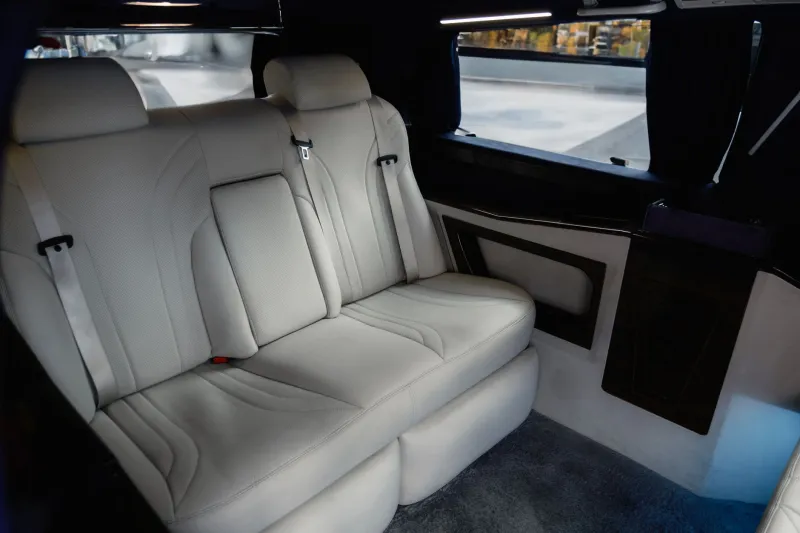
The distinction between a ride-sharing application and a dedicated luxury transfer service is not, fundamentally, a distinction between economy and luxury. It is a distinction between reactive logistics and proactive risk management.
A professional chauffeur service operating in Ho Chi Minh City brings a set of capabilities that no app can replicate. The knowledge is hyperlocal in a way that digital mapping cannot approximate — which building entrance serves which type of visitor, which approach routes become impassable on which days of the week, which hotel lobbies have loading restrictions that affect pickup timing, and which seemingly minor navigational choices cascade into significant time differences during high-traffic periods.
Equally important is the pre-journey intelligence. A dedicated service confirms the pickup location in advance, communicates directly with the property or venue if necessary, and arrives positioned correctly before the passenger ever steps outside. There is no circling. There is no phone call conducted across a language barrier while standing on a crowded sidewalk. There is a vehicle, in position, at the appointed time.
For the executive whose schedule is built around sequential commitments — airport to hotel, hotel to client offices, offices to a business dinner — the compounding value of this reliability is substantial. One delayed transfer does not merely affect one meeting. It compresses or eliminates preparation time for every subsequent engagement in the day.
The Risk Management Reframe
American executives are accustomed to thinking rigorously about risk in the domains of finance, compliance, and operations. Ground transportation in an unfamiliar city rarely receives the same analytical attention, which is precisely why it so often becomes the vector through which carefully constructed business strategies unravel.
The relevant question is not whether a luxury transfer service costs more than a ride-sharing application. It does, and the difference is not meaningfully large relative to the cost of the trip itself, the value of the meetings it supports, or the reputational capital at stake in every interaction.
The relevant question is what the premium purchases. The answer is certainty — the removal of a category of risk that is entirely avoidable and entirely unnecessary for any executive who plans accordingly.
In a city as dynamic, complex, and opportunity-rich as Ho Chi Minh City, the executives who perform best are invariably those who arrive having eliminated every controllable variable. They walk into rooms composed, prepared, and precisely on time. They did not achieve that condition by trusting an algorithm with their most important professional moments.
They arranged for someone who actually knows the city to take them there.