Degrees of Advantage: How Cabin Temperature Shapes Your Negotiating Power in Ho Chi Minh City
Ho Chi Minh City does not ease you in gently. Step off any aircraft at Tan Son Nhat International and the atmosphere meets you like a wall—dense, humid, and unrelenting, often registering above 90°F with humidity levels that push the heat index well past what the thermometer alone suggests. For the business traveler arriving from Chicago, New York, or Los Angeles, the contrast is not merely uncomfortable. It is physiologically disorienting in ways that carry direct consequences for every professional engagement that follows.
Most executives account for jet lag. Fewer account for heat stress. And almost none account for the specific, measurable ways in which thermal discomfort degrades the very cognitive faculties they depend upon most—memory recall, strategic thinking, impulse control, and the capacity to read a room. This is precisely why the climate management inside your transfer vehicle deserves the same deliberate attention you give to your briefing documents and your meeting agenda.
What the Science Actually Says About Heat and Decision-Making
Research in environmental psychology has consistently demonstrated that elevated ambient temperatures impair executive function. Studies conducted across multiple disciplines—from behavioral economics to occupational health—point to a measurable decline in working memory, reduced capacity for complex reasoning, and a heightened tendency toward reactive rather than reflective decision-making when core body temperature rises even modestly.
In practical terms, this means that a professional who spends twenty minutes in humid, poorly conditioned transport before a critical negotiation arrives at the table already operating below baseline. The effect is not dramatic enough to be immediately obvious—you will not feel impaired in the way that fatigue or illness announces itself—but the degradation is real, cumulative, and consequential. The counterpart across the table, who has been working in climate-controlled offices all morning, holds a physiological advantage they may not even recognize they possess.
Elite ground transportation providers understand this dynamic intuitively, even when their clients do not articulate it. Maintaining a precisely calibrated cabin environment is not hospitality theater. It is a functional service with measurable professional outcomes.
The Humidity Variable That Americans Consistently Underestimate
For travelers accustomed to the dry heat of Phoenix or the temperate summers of the Pacific Northwest, Ho Chi Minh City's combination of heat and humidity represents a qualitatively different challenge. Humidity inhibits the body's primary cooling mechanism—perspiration evaporation—which means the body retains heat far more aggressively than in arid climates at equivalent temperatures.
The result is that even a short transit across the city, perhaps fifteen minutes from a hotel in District 1 to a business park in Binh Thanh, can leave a traveler visibly uncomfortable if the vehicle's climate system is inadequate. Perspiration on a pressed shirt, a flushed complexion, a slight elevation in heart rate—none of these are catastrophic individually, but collectively they undermine the composed, authoritative presentation that high-stakes business demands.
A properly maintained luxury transfer vehicle addresses this not simply by running the air conditioning, but by achieving and sustaining a specific thermal equilibrium before the passenger even enters the cabin. The distinction is meaningful. Stepping into a vehicle that is still cooling down from sitting in direct sun is an entirely different experience from stepping into one that has been pre-conditioned to a consistent, comfortable temperature. The latter signals operational professionalism from the first moment of contact.
Comfort as a Cognitive Reset Mechanism
There is a second dimension to climate control that receives even less attention than the physiological one: its role as a psychological reset mechanism between engagements.
The typical Ho Chi Minh City business itinerary for a visiting US executive is compressed and sequential. A morning meeting in the central business district, a working lunch across town, an afternoon session with a different stakeholder group, and perhaps a formal dinner in the evening. Each transition between these engagements represents a brief window—rarely more than twenty to thirty minutes—in which the executive must decompress from one context and prepare for the next.
A thermally comfortable, acoustically controlled cabin transforms that transit window into something genuinely restorative. The nervous system, which has been operating under sustained social and professional pressure, benefits measurably from a period of mild sensory reduction. Comfortable temperature is a primary component of that reduction. When the body is not expending regulatory effort to manage heat stress, cognitive resources are freed for reflection, preparation, and strategic recalibration.
This is why experienced business travelers who have spent significant time in Southeast Asia often describe their transfer vehicle not merely as transportation but as the most productive interval in their day. The vehicle becomes, in effect, a mobile recovery environment—and temperature management is its foundational variable.
What Distinguishes Elite Climate Management from Adequate Air Conditioning
Not all climate control is equivalent, and the distinction matters more in Ho Chi Minh City than in most other business destinations.
Standard air conditioning in a mid-tier vehicle addresses temperature in a blunt, reactive way—the system responds to heat after it has already accumulated, cycles unevenly, and often creates uncomfortable cold zones near vents while leaving other areas insufficiently cooled. For a passenger in business attire, this inconsistency is more disruptive than it might appear.
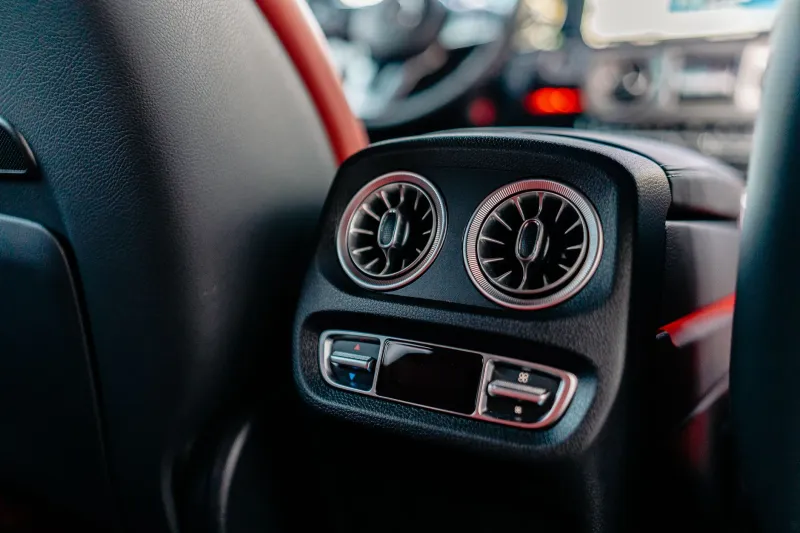
Luxury transfer vehicles deployed by premium providers feature multi-zone climate systems capable of maintaining differentiated temperatures across the cabin, independent humidity management, and pre-conditioning protocols that ensure the environment is optimized before departure. Seat ventilation in higher-specification vehicles addresses the contact surface—often the most significant source of discomfort during humid conditions—directly rather than relying solely on ambient air management.
Beyond the mechanical specifications, there is a service dimension that is equally important. A trained professional driver monitors passenger comfort actively, adjusts settings without being prompted, and understands that the goal is not simply to avoid complaint but to proactively maintain the conditions under which their passenger performs best.
The Compounding Effect Across a Full Business Trip
Consider the arithmetic of a four-day business visit to Ho Chi Minh City. Multiple transfers daily, each lasting between fifteen and forty-five minutes depending on traffic conditions and district distances. Over the course of the trip, a traveler using premium climate-controlled transportation accumulates several hours of thermally optimized transit time—hours during which their cognitive baseline is preserved rather than depleted.
Contrast that with a traveler relying on ride-sharing applications or inadequately maintained vehicles, who arrives at each successive engagement carrying the residual physiological cost of prior thermal stress. The cumulative differential is not trivial. It manifests in the quality of attention brought to afternoon sessions, the patience available for extended negotiations, and the emotional steadiness required for relationship-building at business dinners.
In Saigon's competitive corporate environment, where relationships are built incrementally and first impressions carry lasting weight, that differential can quietly determine outcomes that no amount of preparation in the conference room can fully compensate for.
Arriving in the Condition You Prepared For
The most fundamental argument for elite climate-controlled ground transportation in Ho Chi Minh City is straightforward: you have invested significantly in preparation, in travel, and in the professional relationships that brought you here. The cabin environment of your transfer vehicle is the final variable between that preparation and its expression at the negotiating table.
Arrive cool, composed, and cognitively intact—and you perform at the level you prepared for. Arrive thermally stressed, even mildly, and you perform at something less. In a city as dynamic, competitive, and unforgiving of distraction as Saigon, that margin is not one that serious business travelers can afford to surrender.