Sealed Lips, Open Doors: The Strategic Value of Absolute Driver Discretion in Saigon's Corporate Arena
There is a particular kind of silence that experienced executives learn to value — not the silence of an empty room, but the deliberate, professional quiet of a driver who understands that what travels inside the vehicle stays inside the vehicle. In Ho Chi Minh City, where business relationships are forged at speed and competitive intelligence is currency, that silence carries extraordinary weight.
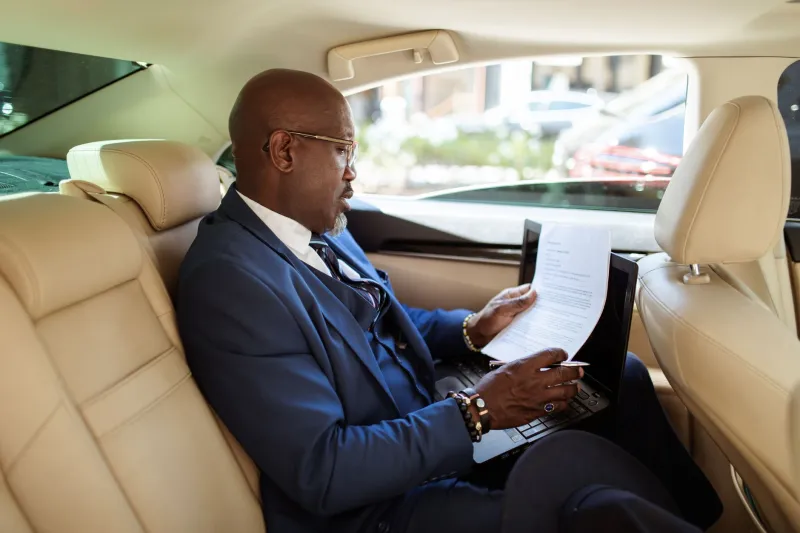
For US executives operating in Saigon's dynamic commercial landscape, the ground transfer is rarely just transportation. It is, more often than not, an extension of the working day — a pressurized interval during which deal terms are rehearsed, legal strategies are refined, and frank assessments of partners and competitors are spoken aloud. The question is not whether sensitive conversations happen in transit. They do, without exception. The question is who is listening.
The Anatomy of a Confidential Conversation
Consider the typical sequence of a high-stakes business day in Ho Chi Minh City. A US executive lands at Tan Son Nhat International Airport, clears customs, and is met by a driver. Before the vehicle reaches District 1, that executive may have already placed three calls — one to legal counsel back in New York, one to a financial advisor reviewing acquisition terms, and one to a colleague debriefing on a competitor's recent market moves in Southeast Asia.
None of these conversations are casual. All of them are sensitive. And every word is spoken within earshot of the driver.
This is the reality of executive transit, and it is one that many business travelers acknowledge only in retrospect — typically after an uncomfortable realization that information shared in transit reached parties it was never intended to reach. In a city as commercially interconnected as Saigon, where business communities overlap and professional networks are dense, the risk is not hypothetical.
What Professional Discretion Actually Means
The term "discretion" is used loosely in the transportation industry, but its meaning within elite limousine services is precise and non-negotiable. At its core, professional discretion encompasses three distinct obligations.
The first is conversational privacy — the understanding that a driver does not engage with, repeat, or react to any portion of a passenger's business discussions. This is not passive behavior. It is a trained discipline, one that requires a driver to mentally compartmentalize what is heard and treat it as categorically inaccessible.
The second is relational confidentiality. An elite driver does not confirm or deny the identities of clients, the nature of their travel, or the destinations they frequent. In a city where corporate competitors often share the same five-star hotels, the same private dining rooms, and the same financial districts, even a casually confirmed sighting can shift a negotiating dynamic.
The third is informational neutrality. A driver affiliated with a truly professional service does not act as a conduit — intentional or otherwise — between competing clients. The temptation to share market intelligence, however subtly, is a structural risk in services that lack rigorous ethical standards. Elite operators eliminate this risk through vetting, training, and operational protocols that treat client information as permanently sealed.
The Saigon Variable: Why This City Demands Higher Standards
Ho Chi Minh City is not a market that forgives informational carelessness. Its business culture is sophisticated, its commercial relationships are layered with history and mutual observation, and its most influential players are exceptionally well-networked. What might pass as an innocuous disclosure in a less concentrated market can reverberate through Saigon's business community with surprising speed.
US executives entering this environment for the first time — or even those returning for subsequent engagements — sometimes underestimate the degree to which information travels. A casual remark made in the back of a vehicle, repeated to a single contact, can alter perceptions, shift leverage, and compromise negotiations that took months to construct.
This is not an argument for paranoia. It is an argument for precision. And precision, in the context of ground transportation, begins with selecting a service whose discretion standards are institutionalized rather than incidental.
The Driver as Strategic Asset
There is a counterintuitive dimension to this conversation that deserves direct attention: the truly elite driver is not merely a passive guardian of your secrets. In the right service context, they are a source of calibrated, ground-level intelligence that no consultant's report can replicate.
A professional chauffeur who has served Saigon's executive community for years accumulates a form of knowledge that is both granular and current. They understand which neighborhoods are undergoing commercial transformation, which hotels are favored by which nationalities of business travelers, which traffic corridors become impassable during specific seasonal events, and which logistical variables — a government summit, an international trade expo, a major infrastructure closure — will affect an executive's ability to move efficiently across the city.
This intelligence is offered appropriately, not intrusively. A skilled driver knows the difference between useful contextual information and overreach. They volunteer what is relevant to your schedule and your comfort, and they withhold everything else. That calibrated judgment is itself a form of professional excellence.
Building a Relationship That Compounds Over Time
US executives who travel to Ho Chi Minh City repeatedly — for ongoing negotiations, quarterly reviews, or sustained partnership development — consistently report that the relationship with a trusted driver becomes one of their most reliable professional assets in the city.
This is not sentiment. It is operational logic. A driver who knows your preferences, your schedule patterns, your communication style, and your tolerance for briefing during transit becomes a seamless extension of your professional infrastructure. You spend less time managing logistics and more time managing outcomes. You arrive at every engagement with your attention intact rather than fragmented by navigational uncertainty or vehicular unpredictability.
More importantly, you arrive knowing that everything discussed in transit remained precisely where it was spoken — inside the vehicle, inaccessible to the market forces working against your interests.
Choosing the Standard That Protects You
Not every limousine service in Ho Chi Minh City operates at this standard. The distinction between a premium vehicle and a genuinely elite service is not cosmetic — it is cultural, procedural, and deeply consequential for executives whose professional exposure is significant.
When evaluating a ground transportation provider in Saigon, the relevant questions extend well beyond fleet quality and punctuality. How are drivers selected? What confidentiality training do they receive? Are there explicit protocols governing how client information is handled internally? Does the service maintain separation between client profiles to prevent informational crossover?
These are not excessive demands. They are the baseline expectations of any executive who understands that in Saigon's business arena, silence is not merely golden — it is strategic.
Your vehicle moves through the city. What you say inside it should stay there. Choose accordingly.