The Long Campaign: How Elite Transit Becomes Your Mental Sanctuary During Extended Ho Chi Minh City Assignments
The first week in Ho Chi Minh City tends to feel manageable. The jet lag is still a novelty, the energy of the city is stimulating rather than draining, and the novelty of the assignment keeps your adrenaline engaged. By week three, the calculus shifts entirely.
Back-to-back meetings with Vietnamese partners, late dinners that run past midnight, mornings that begin before the city's heat reaches its peak — these are not aberrations for the US executive on an extended Saigon assignment. They are the rhythm. And that rhythm, sustained without deliberate recovery, degrades the very faculties you flew fourteen hours to deploy.
The question serious executives should be asking is not whether fatigue is accumulating. It is: where, precisely, does the opportunity to reverse it exist?
The answer, for those who have learned to use their environment strategically, is already waiting at the curb.
The Compounding Cost of Ignored Fatigue
American business culture tends to treat exhaustion as a badge of commitment. Log the hours, absorb the strain, push through. In domestic settings, this posture has a certain functional logic — you are operating in a familiar environment, on home time, with the full support of institutional infrastructure around you.
In Ho Chi Minh City, that logic inverts.
You are operating across a twelve-hour time difference from your home base, in a city whose pace, density, and sensory intensity have no equivalent in most American metros. The cognitive load of navigating unfamiliar business customs, conducting negotiations through interpreters, and managing real-time communication with your US office across incompatible time zones is genuinely cumulative. Research on decision fatigue consistently demonstrates that the quality of judgment erodes with each successive high-stakes choice made without recovery — and in Saigon, those choices come in rapid succession from the moment you step outside your hotel.
The executive who ignores this physiological reality is not demonstrating discipline. They are quietly surrendering the sharpness that justifies their presence here in the first place.
Why the Vehicle Is the Only True Recovery Zone
Hotels offer rest, but not always at the right moment. Conference rooms offer structure, but no relief. Restaurants offer nourishment alongside the social performance that comes with every business meal in Vietnam.
The interior of a luxury limousine offers something none of those environments can: complete, consequence-free privacy at the precise intervals when you need it most.
Consider the typical schedule of a senior executive in the middle of a three-week Saigon engagement. Morning transfer from hotel to a manufacturing facility in Biên Hòa. Midday transfer back into District 1 for a working lunch. Afternoon transfer to a legal consultation in Thủ Đức. Evening transfer to a private dinner in District 3. Each of those transit windows — ranging from fifteen minutes to over an hour depending on traffic — represents a recovery interval that most executives squander by defaulting to email or phone calls.
This is not a trivial loss. These are the only unscheduled, unobserved, undemanding moments in the day. And they are being spent extending the cognitive load rather than reducing it.
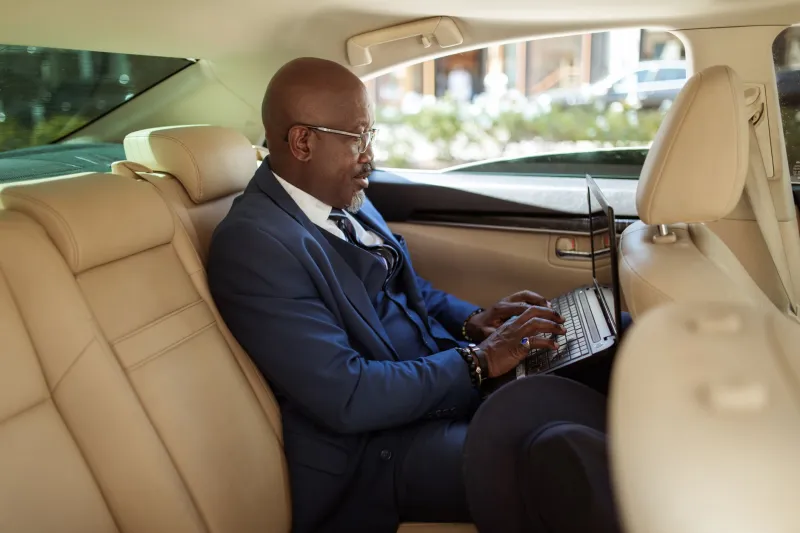
A well-appointed luxury vehicle, with its acoustic insulation, climate-controlled interior, and the implicit social contract of non-interruption, creates the conditions for genuine mental decompression — if you choose to use it that way.
A Practical Protocol for the Transit Recovery Window
Decompression during transit does not require meditation training or elaborate preparation. It requires a deliberate decision, made in advance, about how you will use each window. The following approach has been adopted by experienced executives who manage extended Vietnam assignments with sustained effectiveness.
The first five minutes: physical reset. Upon entering the vehicle, resist the instinct to immediately check your phone. Instead, set it face-down. Adjust your seating position. Allow your shoulders to drop. The body carries the tension of every meeting forward until something signals it to release. The transition into a quiet, comfortable cabin is that signal — but only if you allow it to function as one.
The middle interval: selective mental review. This is not the time for active problem-solving or email composition. Rather, allow the preceding engagement to surface naturally — what was said, what was implied, what requires follow-up. This passive review, conducted without a screen in front of you, tends to yield insights that active note-taking during a meeting suppresses. Vietnamese business negotiations in particular carry significant subtext, and the transit window is where that subtext often becomes legible.
The final five minutes: intentional preparation. Before arriving at the next destination, spend a brief, focused period orienting yourself to what comes next. Review one or two key objectives. Not the full briefing document — a single clear intention. This replaces the scattered, reactive mindset that arrives when you've been on your phone the entire ride with a composed, directed presence that registers immediately to the people waiting to receive you.
What Saigon's Traffic Actually Gives You
Americans accustomed to the grid logic of US cities often experience Ho Chi Minh City's traffic as an obstacle. The reality, for the executive who reframes it, is rather different.
Saigon's traffic means that transit times are generous. A journey that might take eight minutes in a quieter city takes twenty-five here. Cross-district transfers during peak hours can extend to forty-five minutes or more. These are not delays. They are the longest uninterrupted recovery windows your schedule will produce all day.
A professional limousine service that knows the city's traffic patterns will route you with this in mind — choosing paths that balance efficiency with the practical reality that a slightly longer route through less congested streets may arrive at the same time while providing a quieter, smoother ride. That distinction matters when the ride is functioning as a recovery tool rather than simply a means of locomotion.
The Multiplier Effect Across a Long Assignment
The executive who uses transit time as a decompression chamber does not simply feel better on any given afternoon. Over the course of a three- or four-week assignment, the compounding effect of consistent micro-recovery is measurable in ways that matter professionally.
Decisions made in the final week of a long engagement retain the quality of decisions made in the first. Negotiations that would otherwise be clouded by accumulated fatigue remain clear. The cultural attentiveness required to read a Vietnamese business partner's signals — which demands genuine cognitive bandwidth — remains available when it is needed most.
That is the competitive advantage that elite ground transportation provides on an extended Saigon assignment. Not comfort for its own sake. Not status signaling. A repeatable, reliable mechanism for protecting the mental capital that every business outcome here ultimately depends upon.
The distance between executives who close deals in Ho Chi Minh City and those who simply attend meetings is rarely found in their preparation or their credentials. It is found, more often than anyone acknowledges, in how they spent the time between.